
Deed Types in Cherokee Records
The Clerk of Courts runs deed recording through its Deeds and Records division. The index there covers deeds, security deeds, easements, liens, plats, trade names, and UCC-related filings. Type matters. A conveyance transfers an interest. A security deed backs a debt. A lien asserts a claim against the land. Before treating any single entry as the full chain, read the image. Also read any later releases or cross-references.
| Deed Type | What It Does | Common Use |
|---|---|---|
| Warranty deed | Conveys the stated interest with deed warranties | Ordinary sale or transfer |
| Quitclaim deed | Conveys whatever interest the grantor holds | Interest release or chain cleanup |
| Executor or trustee deed | Conveys through authorized estate or trust action | Estate and trust transfer |
| Foreclosure deed / deed in lieu | Records a foreclosure-related conveyance | Distressed-property chain |
| Security deed | Secures debt against the described land | Loan, assignment, cancellation, or modification trail |
| Tax deed | Records the outcome of a tax-sale process | Tax-sale chain subject to separate redemption issues |
In Georgia, a security deed can also appear as a deed to secure debt, a loan deed, or a warranty deed to secure debt. The Clerk requires first-page details such as the parties, loan and maturity data, parcel information where it applies, the legal description, signatures, a witness, and a notary. Those requirements govern execution. They do not convert the security instrument into a sale deed.
Current Cherokee Deeds in Landmark
The Clerk's current local system is the Cherokee Landmark portal. It covers Real Estate, Lien, and Plat categories. Coverage runs from 1989 to the present, with book and page images viewable online. Because the search form is dynamic, field labels and required inputs can shift. The county's search landing screen identifies this modern deed route.
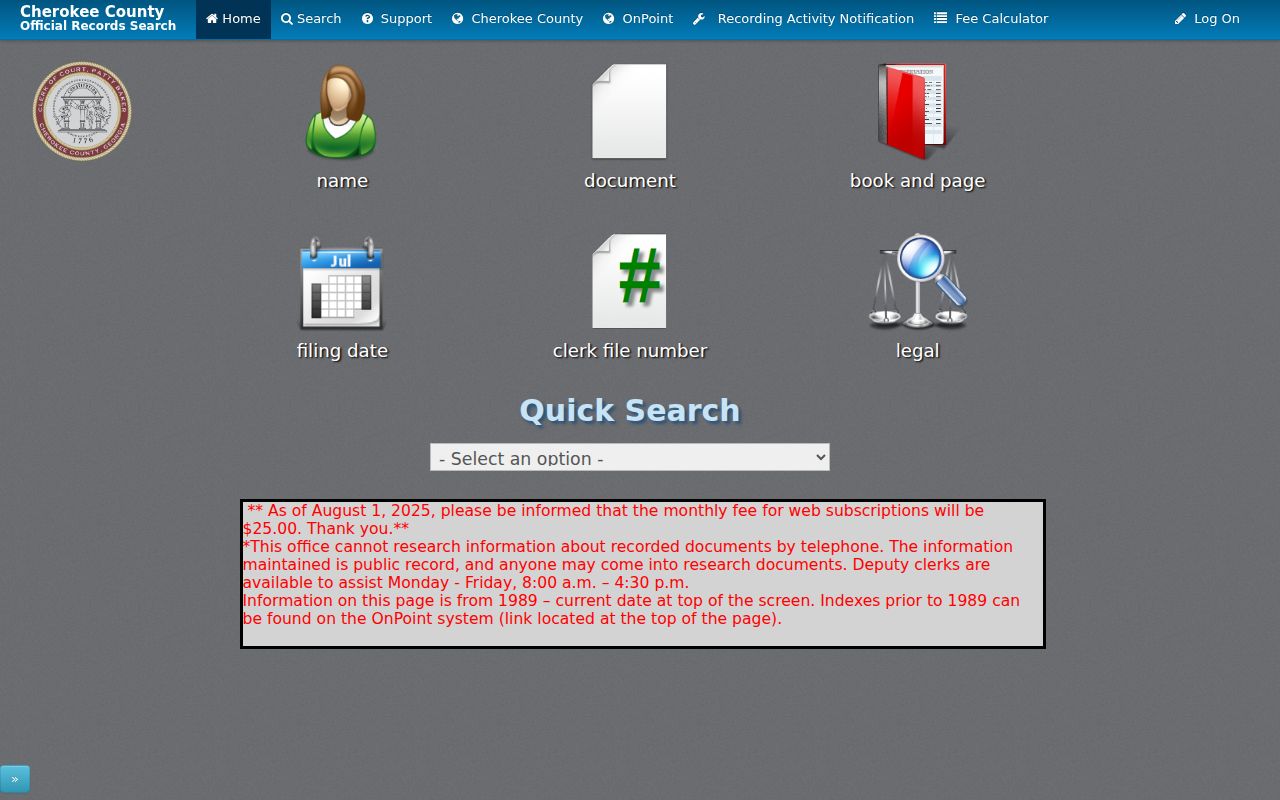
Open the image from the result citation. Then save both the index data and the copy's certification status.
Follow Cherokee Grantors and Grantees
A grantor-grantee index chains each transfer through its parties. Start with the current parcel. Pull the latest sale book and page from Spatialest. Find that instrument and read its grantor, grantee, and land description. To reach further back, search the prior grantor as a grantee. Use an earlier date range for that step. Keep going only while the legal description and parcel clues still line up.
- Find the latest purchase instrument with the current recipient as grantee.
- Record the grantor, date, book/page, and exact legal description.
- Search that grantor as an earlier grantee and compare the same land.
- Repeat to the online cutoff, marking any break rather than guessing.
- Grantor
- The party that conveys the stated interest.
- Grantee
- The party that receives the stated interest.
- Chain of title
- The linked sequence of recorded transfers for the same land.
- Book/Page
- A Clerk citation used to locate a recorded instrument or image.
- Instrument number
- A separate unique filing reference where the index supplies one.
Cherokee OnPoint and the Gap
The Clerk links a separate OnPoint real-estate index for research before 1989. A county FAQ, however, tells another story. It states that records from July 1979 through 1987 cannot be viewed. They cannot be searched either. So the route is real, but so is the gap. It is not a continuous digital deed run.
For the missing period, bring party names to the courthouse terminal or counter. Bring the document type too. An approximate date helps, and so does any book and page. Georgia Archives finding aids can supply leads. So can microfilm, the Cherokee library Genealogy Room, and old newspaper notices. Every lead must return to a Clerk-held instrument before it belongs in a deed chain.
The older-system screen marks the historical path.
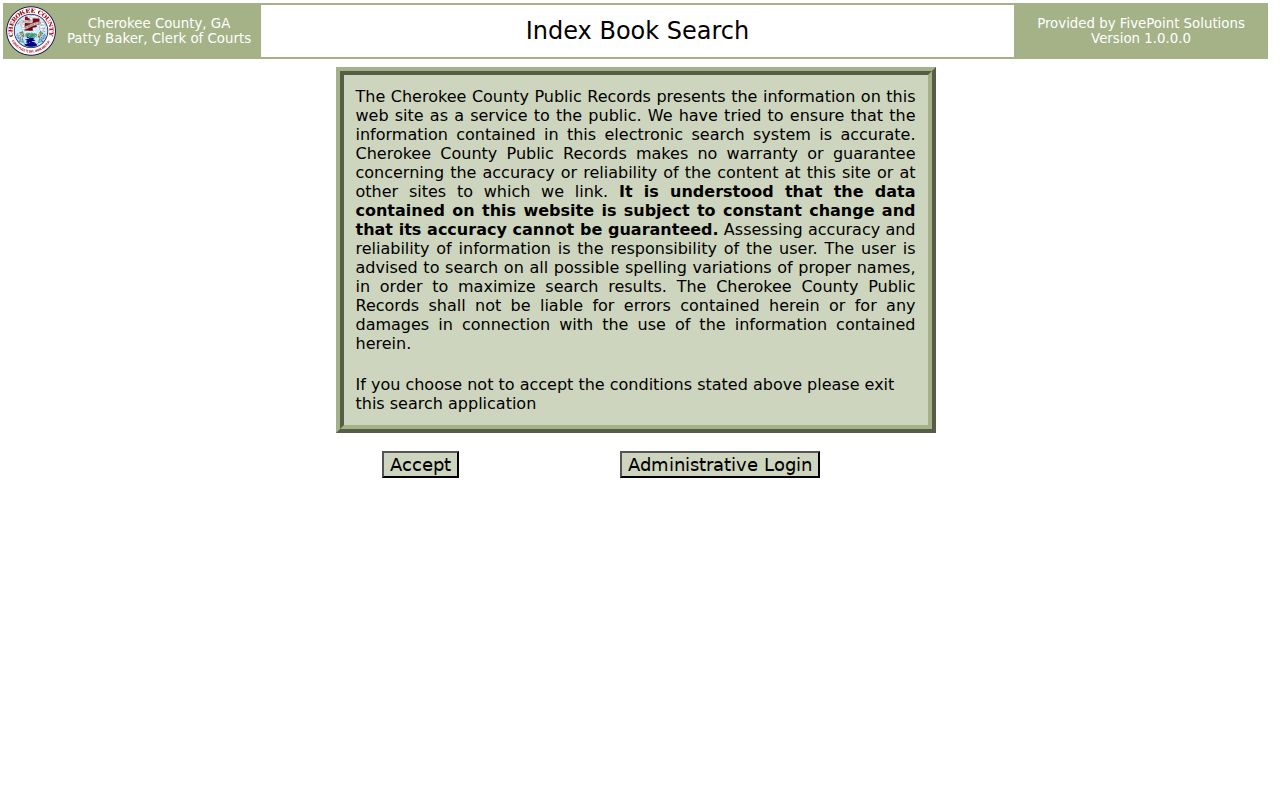
The older interface does not erase the documented 1979-1987 online viewing and search gap.
Statewide Fields for Cherokee Deeds
The GSCCCA Real Estate Index offers a statewide way to cross-check Cherokee County deed records. Search fields include name, property description, subdivision, unit, block, and lot. You can also search by county, book and page, date range, party type, instrument type, and geographic filters. Its public documentation places statewide deed index data from January 1, 1999 forward. Historical data is added over time. That scope differs from the Clerk's 1989 Landmark claim.
| Search field | Input | Practical use |
|---|---|---|
| Party name | Text and party role | Run grantor and grantee directions with variants |
| Property description | Subdivision/unit/block/lot or land clues | Separate names tied to different land |
| Book/page | Paired citation | Reach one precise index and image lead |
| Date range | Filed dates | Narrow a transfer period |
| Instrument type | Category | Separate deed, lien, plat, and related entries |
Indexing standards call for grantor, grantee, document type, filed date and time, book and page, general description, land lot, district or GMD, subdivision fields, and cross-references. Local labels can differ.
Plats Behind Cherokee Lot Descriptions
A Cherokee County deed often describes land by lot and block. That description traces back to a recorded plat. Plats carry detail an index row cannot hold, including captions, common areas, easements, rights-of-way, and dedications. So the plat itself is worth pulling whenever a lot line matters. The Clerk requires modern plats to be filed electronically under HB 1004 and O.C.G.A. §15-6-67.
GIS layers add another angle. County and municipal mapping draws on recorded plats, resolutions, plans, and annexation data. That makes it a handy way to find the land first. Still, a map layer is only a picture of the record, not the record itself. For the true legal layout, request the filed plat image. Or order a new boundary survey instead.
Garrison Saved Cherokee Records
Cherokee County's budget history recounts that Clerk John B. Garrison hid courthouse papers at his home as Union forces neared Canton in 1865. The courthouse burned anyway, and courts met in a church until a replacement opened in 1874. Another courthouse burned in 1928. The story shows why custody research matters. It cannot prove any particular deed book survived.
For a volume-level question, ask the Clerk and Georgia Archives what is held, imaged, or microfilmed. The library's county books, surname files, family histories, and newspapers can recover an old name or place reference. Those secondary records stay leads. They never replace the deed itself.
Order a Cherokee Deed Copy
Copies of a Cherokee County deed are cheap to get. Regular online copies are free. At the courthouse, public-terminal copies run $0.50 per page. Clerk-assisted copies cost $1 per page. Mailed regular copies also cost $1 per page. Certified copies add a $2 seal fee plus $0.50 per page. The Clerk's copy instructions walk through every main access channel. Georgia also offers an eCertified route.
For a mail request, state the names and the document title and type. Enclose payment, and add a self-addressed stamped envelope. Send it to 90 North Street, Suite G-150, Canton, GA 30114. Deputy-clerk counter service generally runs weekdays from 8:00 a.m. to 4:30 p.m., though closures happen, so check notices before traveling. Staff will explain the process. What the office will not do is research recorded documents over the phone.
Recorded, not guaranteed. Cherokee County deed records show what reached the index. They do not rule out unrecorded interests or provide a legal opinion on title, validity, or lien priority.
Watch Cherokee Filing Activity
FANS is Georgia's Filing Activity Notification System, and it is free. You register a property. It then sends an alert when a deed, lien, or other filing enters the index. That early warning helps with deed-fraud awareness. It is not a certified title search, though. An alert never proves the filing validly changed ownership.
Save any alert you get. Then search the official Cherokee index and read the recorded image. A filing may still look wrong. Contact the Clerk for process information and seek qualified legal advice. Treat neither the email nor the index label as the land's final legal status. The official FANS enrollment screen shows the state notification service.
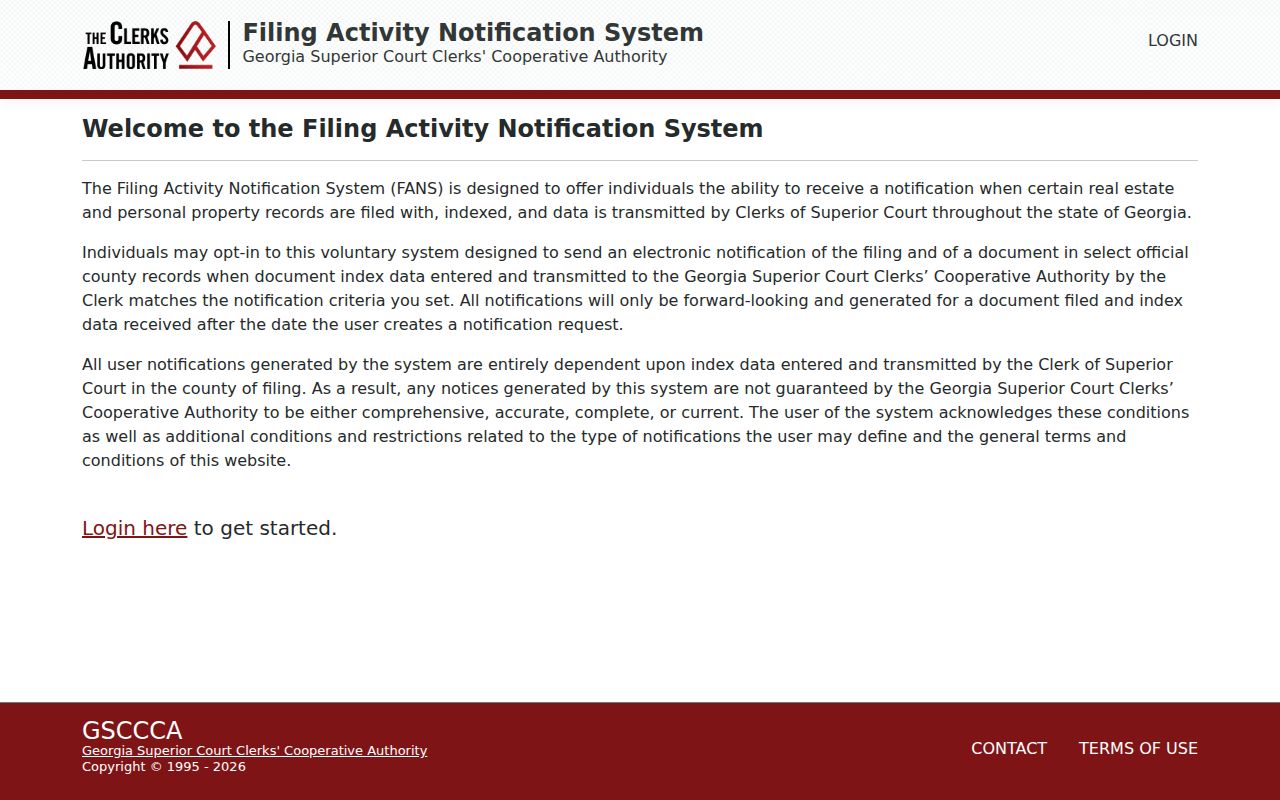
Alerts help, but a certified Cherokee County instrument still governs.