
Read the Cherokee County Property Tax Record
No single card holds a full tax record. The Tax Assessor keeps the parcel description and classification. It also holds the fair-market-value opinion, assessed amount, sales history, and exemption details. The Tax Commissioner builds the bill from that assessment. That office also collects payments, tracks delinquency, and runs the levy and tax-sale process. Match the parcel and tax year across both records. That way a payment entry never gets mistaken for a valuation.
| Tax field | Meaning in the record | Official source |
|---|---|---|
| Fair market value | The assessor's opinion of full value as of the annual valuation date | Assessor card and annual notice |
| Assessed value | Ordinarily 40% of fair market value before program-specific treatment | Assessor card |
| Value components | Residential, commercial, accessories, land, total, and prior value fields | Spatialest parcel card |
| Exemptions | Homestead or other approved relief affecting taxable value | Assessor forms and notice |
| Bill and status | Tax-year charge, payment, balance, interest, penalty, or Fi.Fa. stage | Tax Commissioner account |
A sale price tells a different story. Spatialest reports the sale date, deed type, qualified status, price, and whether the parcel was vacant or improved at the time. Those fields explain a transaction. They still cannot stand in for assessed value or the amount due on a Cherokee County tax bill.
Search Cherokee County Assessment Fields in Spatialest
The direct Cherokee County Spatialest search accepts four primary keys. None of them is required in every case. Start with the cleanest key you have. Then compare the parcel card against the legal description and tax district before calling it the right property.
| Portal control | Input | Best use |
|---|---|---|
| Account | Text or suggestion | Match a known assessment account |
| Address | Street-address text | Start from a situs address |
| Parcel | Text or suggestion | Preserve the exact parcel identifier |
| Owner | Text or suggestion | Find parcels under a person, trust, or entity name |
Results can be ordered by account, address, or parcel. The card then separates key information from value, building, and sales sections. Advanced filters narrow a result set by living area, sale date, bedrooms, and land size. Filters never change the underlying record. The portal caps results at 400. Excel export stops at 250. Exports cost $3 for Excel and $1 for a mailing list.
The official assessor search opens the assessment half of any property tax lookup.
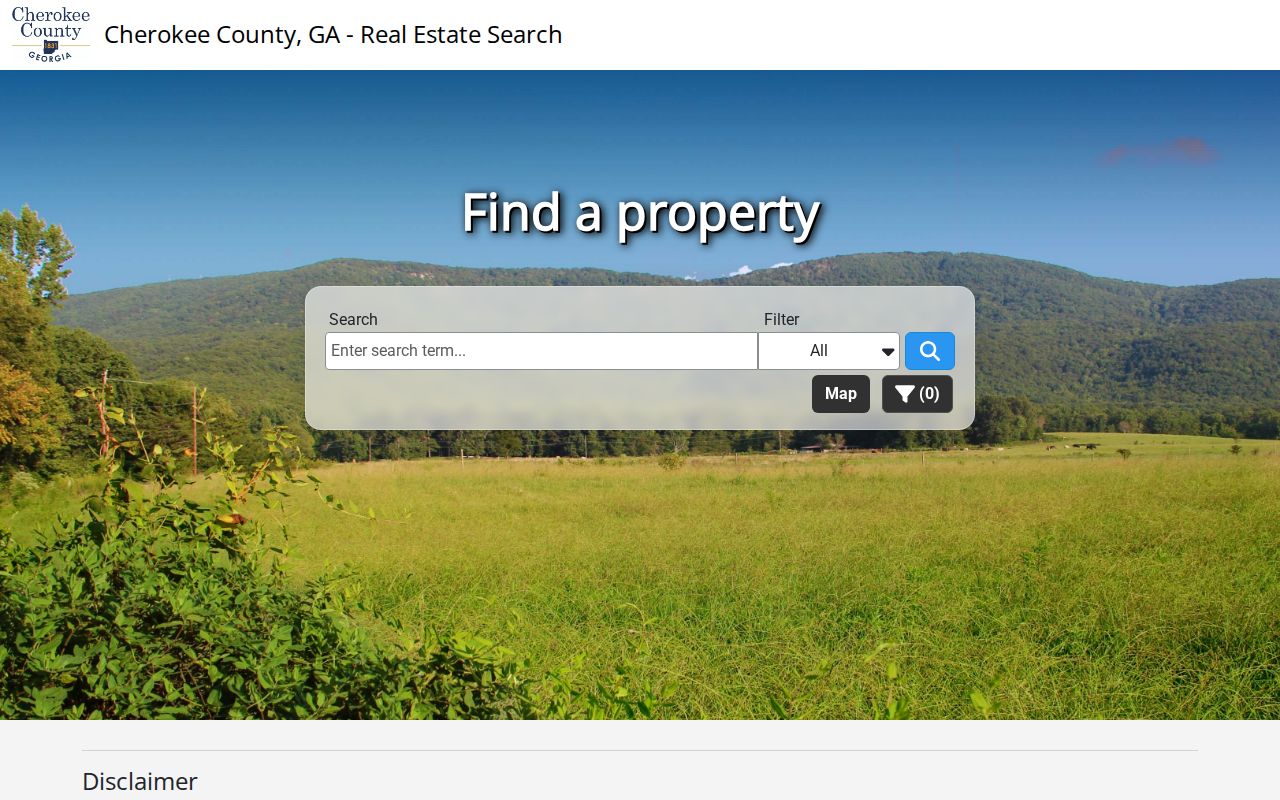
From there the search leads to the parcel card. Save the tax year, parcel ID, owner label, values, and sales details, along with the date of the search.
Note: The portal displayed a September 7, 2026 data timestamp, not a guarantee that every recent deed had reached every field.
How Cherokee County Property Tax Values Are Split
One total never tells the whole story. The assessment area of the Cherokee County card breaks out Residential Value, Commercial Value, Accessories Value, Land Value, Total Value, and Prior Value. That split shows where a year-to-year change happened. Building inventory goes deeper still. It can list actual and effective year built, living area, property type, exterior and interior attributes, story height, roofing, foundation, condition, heat, bedrooms, bathrooms, and fireplaces.
- Fair market value
- The assessor's full-value opinion as of January 1 under Georgia's annual system.
- Assessed value
- The value to which tax rules are applied, ordinarily 40% of fair market value for Georgia real property.
- Millage or levy
- The adopted rate applied to the taxable assessment to produce liability.
- Homestead exemption
- Approved owner-occupied relief that can reduce or limit part of the taxable assessment.
- Tax lien
- A claim arising from unpaid property tax, which may progress through Fi.Fa., levy, and sale steps.
Special programs and exemptions complicate the math. Rollback rules can shift that 40% relationship too. Use the notice for the same tax year rather than treating a statewide ratio as a homemade bill calculator.
Cherokee County Property Tax Digest Numbers Need Context
The countywide taxable real-property digest climbed from $20,604,260,135 in 2023 to $21,961,165,595 in 2024. By 2025 it reached $23,931,266,097. That roll spans every parcel together. It cannot measure any single Cherokee County property tax record. Never project its growth rate onto a house, tract, commercial parcel, or city area.
The 2025 assessment material also counted 114,830 taxable parcels. It logged 6,430 new homestead applications and 14,375 spouse additions. Those figures show the scale of annual administration. For one parcel, the prior and current fields, building data, and neighborhood evidence all matter. The notice itself remains the right evidence too.
Trace a Cherokee County Tax Bill from the Parcel
The county links to the official GovernmentWindow tax portal for bill lookups. Its search controls call for some caution. Do not guess at field labels. Instead, carry over the parcel or account details already confirmed in Spatialest. If the online route fails, the Tax Commissioner at 2780 Marietta Highway in Canton, the Woodstock annex at 155 Towne Lake Parkway, or 678-493-6400 can help.
- Find the parcel in Spatialest and save the exact parcel and account numbers.
- Open the Tax Commissioner account for the matching property and tax year.
- Read the billed amount, payment entries, balance, and any interest or penalty as separate fields.
- Return to the assessor notice to check the value and exemptions that fed the bill.
- For a delinquent account, verify Fi.Fa., levy, advertisement, sale, and redemption status with the office.
Cherokee County bills go out in September. Payment is due November 15. Partial payments are accepted. Interest and penalties keep running on any unpaid balance. The tax-account page, assessment card, and payment receipt each serve a different purpose. Retain all three when documenting a disputed payment or balance.
The Tax Commissioner's property page provides the official billing route.
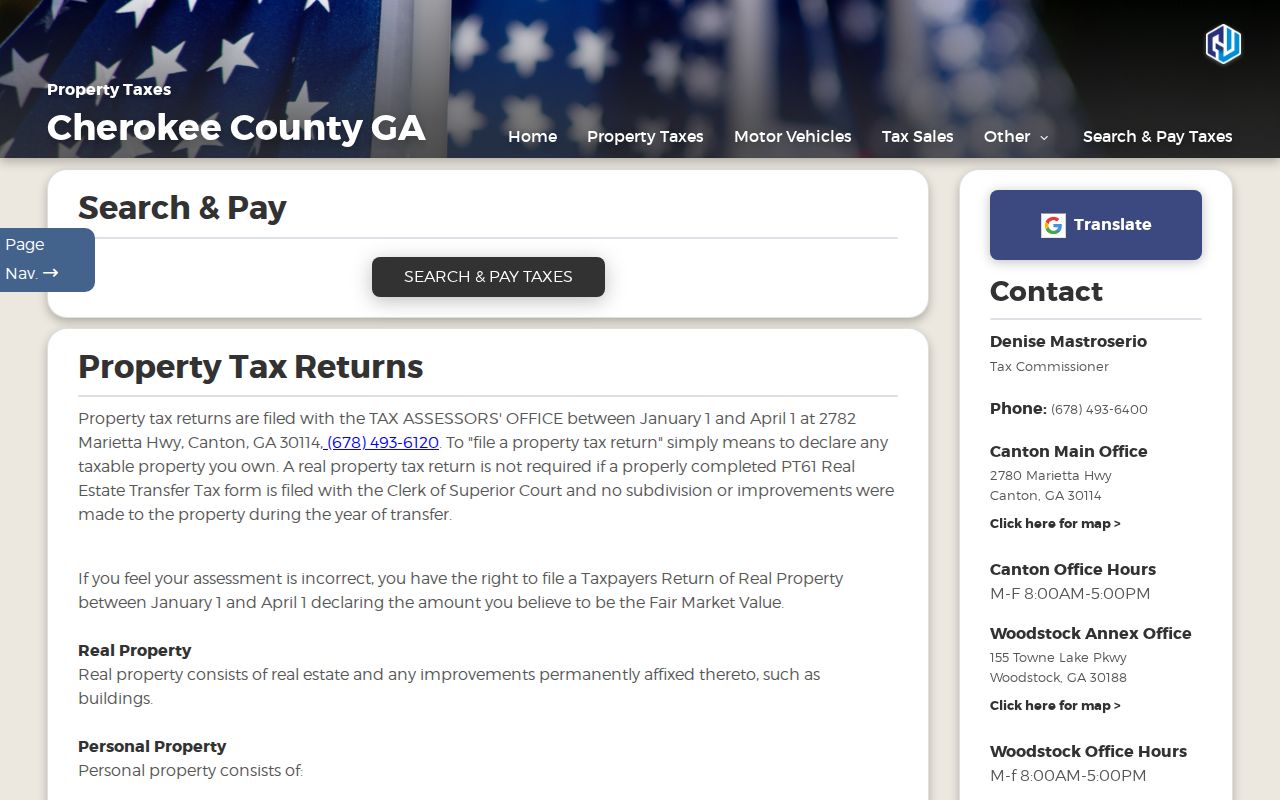
This page sits on the collection side of the process. Values and exemptions still originate with the assessor, whose appraisal work feeds every Cherokee County tax bill tied to a parcel.
January 1 Controls the Cherokee County Tax Roll
January 1 sets the tax roll. The Tax Commissioner's records name the owner of record as of that date. A later sale makes the files look mismatched. The newest deed shows the buyer, but the tax record still keys to the annual owner. This is a timing difference. Neither record is automatically wrong.
A buyer after January 1 may file a property-tax return from January 1 through April 1 of the following year, and a PT-61 may serve as that return when no subdivision, improvement, or change applies. Ownership proof belongs in the deed trail. Annual tax administration rides on the roll date.
Note: Compare the tax year, January 1 owner, deed filing date, and closing date before reporting an ownership discrepancy.
Cherokee County Homestead and Notice Changes
Cherokee County keeps its homestead paperwork in one place. The Tax Assessor forms library holds homestead, senior and disabled, property return, address-change, conservation-use, and business personal property documents. Filing homestead or property applications in person takes Georgia identification showing the current property address. Bring a settlement statement or warranty deed too. Eligibility rules and application details shift. So read the live form for the current year before filing.
Notices have also changed recently. The 2025 notice rewrote Box C. It reworked how rollback rates were presented. County reporting noted that some rates were missing from the estimated-tax calculation. The March 2026 announcement laid out the 45-day appeal window and standard homestead reductions. It also covered the floating homestead's effect on maintenance-and-operation inflationary value. A later 2026 senior-exemption page covered SB 566 and acceptance through the final appeal day. Old instructions are unsafe substitutes for the notice in hand.
The county's assessment and exemption document page appears below.
Pull the current form and its instructions from the live document set before preparing any filing.
From Cherokee County Delinquency to Tax Sale
Unpaid property tax can grow into a lien, then a levy, then a sale. Those stages are distinct. None of them alone proves a parcel has already been sold. Cherokee County's tax-sale instructions spell out the sequence. Legal advertisements run in the Thursday Cherokee Tribune for four straight weeks. The sale itself starts at 10 a.m. on the first Tuesday after the final ad. It is held at the courthouse.
Buyers get no title guarantee from the office. Redemption can involve the sale price plus statutory additions. Excess-funds questions go through a separate contact route. Before drawing any conclusion, check several things. Look at the current advertisement, the account, the sale event, any tax deed, and redemption evidence. A legal notice is a dated lead, not a final title answer.
Contest a Cherokee County Property Tax Assessment
An appeal targets the assessment printed on the annual notice, not just the bill total. Georgia and Cherokee guidance set a 45-day window measured from the notice date. The filing should name the parcel, the tax year, the issue being raised, and the appeal route chosen. Then back the position with parcel-specific facts. Condition, measurements, land characteristics, comparable evidence, or a classification error all count. The Board of Tax Assessors reviews the filing, and later routes follow the current notice and Georgia procedure.
Assessor field visits happen for several reasons: appeals, returns, additions, parcel review, conservation-use matters, or verification under O.C.G.A. §48-5-264.1. Staff carry county identification and drive marked vehicles. A residential review may include measurements and exterior photographs. Answering questions is voluntary. Keep the notice envelope or its issue date, and get a filing receipt.
Protect the deadline. File within 45 days of the notice date using that year's instructions; a typical calendar estimate cannot replace the printed deadline.
Assessment questions go to the Tax Assessor at 2782 Marietta Highway, Suite 200, Canton, 678-493-6120. Bill and payment questions belong to the Tax Commissioner. To understand what assessment, market, and sale figures mean without rebuilding the bill, see the Cherokee County property value guide.