
Trace Cherokee County Former Owners Transfer by Transfer
A backward chain begins with a current deed and works grantor by grantor toward earlier owners of record. Each prior grantor becomes the next name in the Cherokee County property search. The table serves as a working timeline. It is not a claim that every transfer appears in the online deed records.
| Transfer point | Grantor to grantee | Deed evidence | Next move |
|---|---|---|---|
| Current acquisition | Prior owner to current grantee | Date, deed type, book/page, legal description | Search the grantor as an earlier grantee |
| Earlier acquisition | Earlier grantor to that prior owner | Matching land lot, subdivision, lot, block, or acreage | Repeat with the new grantor |
| Parcel split or rename | Parties may differ by tract | Referenced plat and predecessor book/page | Follow each predecessor parcel |
| Estate transfer | Decedent or estate to successor | Probate matter plus recorded deed, affidavit, or order | Resume at the decedent's acquisition |
Record the instrument date and the recording date separately, because the lag between them can separate two same-named sellers. When names repeat, trust the legal description and book-and-page cross-references over a broad name match.
Go Back Through Cherokee Landmark and OnPoint
The Cherokee Clerk's land-record page presents Landmark as the portal for deeds, liens, and plats recorded from 1989 forward, and points researchers to the OnPoint real-estate index for older material. The two systems cover different eras. Read them as separate indexes rather than one continuous stream of images. A county FAQ states that records from July 1979 through 1987 are unavailable for viewing or searching, and the office publishes no fuller detail about the transition years. So a careful former-owner timeline marks the exact spot where the online trail ends. From there, the work moves to the counter, the deed books, and other cataloged holdings.
Online cutoff. Landmark starts with 1989-current records, while the documented 1979-1987 gap requires an offline or custodian-assisted bridge.
Open Cherokee County's Older Ownership Route
The Clerk-linked OnPoint route is the official starting point for pre-1989 index research.
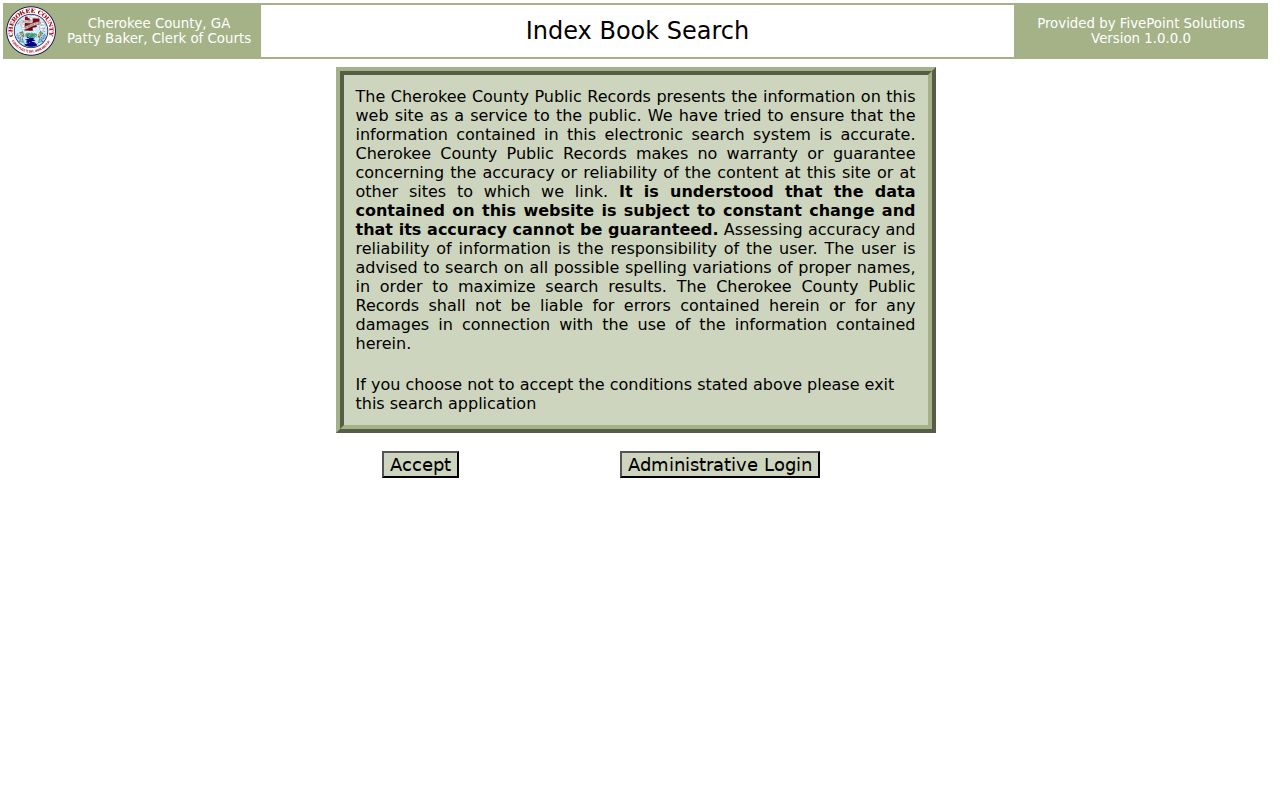
If the older screen returns nothing for your instrument, keep the searched spelling and date range on paper. Take the known book and page, or the legal description, straight to the Clerk.
Reconstruct Cherokee Ownership Despite Name Changes
The county FAQ recommends trying spelling variations. That advice matters most for former owners recorded under initials, alternate surnames, entity forms, or indexing slips. Search both sides of each transfer. Run both the current and former name of an LLC or development whenever the evidence points that way. GSCCCA opens statewide searching by name, county, date, book and page, instrument type, subdivision, unit, block, and lot. Its public documentation places statewide deed-index data back to at least January 1, 1999. Cherokee's own online coverage statement remains 1989 to current. Note: A statewide no-result does not prove that an older Cherokee deed never existed in a local book or index.
Follow Cherokee Plats Through Splits and Old Names
Ownership chains tend to snap where one parcel split into several lots or a subdivision changed its name. Compare subdivision, unit, phase, lot, block, tract, acreage, land lot, district, metes-and-bounds calls, and prior book-and-page references at every single step. A recorded plat can reveal dedications, easements, roads, lot lines, and revision notes that explain why the current GIS map shape no longer matches an older deed. Cherokee plats now follow electronic filing rules. That does not put every historic image online. Pull the Clerk's recorded plat itself rather than trusting a modern tax polygon.
Walk the Cherokee County Deed Chain Backward
Each pass through the loop takes the seller from the last deed and searches for that person as an earlier grantee. Hold the land identity constant while the party names keep changing.
- Find the current acquiring deed and record the grantee, grantor, date, type, book/page, and land description.
- Search that grantor as a grantee in an earlier date range.
- Compare the earlier deed's description and cross-reference with the same land, not merely the same name.
- Repeat until an index gap, estate event, split, or older book requires a new source.
- Grantor / grantee
- The conveying and receiving parties named in an instrument.
- Chain of title
- The linked series of instruments affecting the same land.
- Reverse index
- An index used to find when a named grantee acquired the property.
- Warranty / quitclaim
- Different deed forms whose effect must be read from the instrument, not assumed from a label.
Bridge a Cherokee Former Owner Through Probate
Even a clean sale-to-sale chain can pause at a death. The Cherokee Probate search accepts Case Number, In Matter Of, filing-date ranges, and date-of-death ranges. Use those fields to surface an estate matter. They can also bring up an appointment, petition, or order tied to the former owner.
The probate result is context, not the conveyance itself. Order the file. Then locate the recorded deed, affidavit, or order that actually touched the parcel. A missing deed cannot be replaced by an inference about heirs.
Search Cherokee Newspapers for Former Names
The Cherokee County Public Library Genealogy Room provides Ancestry Library Edition and FamilySearch. Donated county-record books, newspapers, family histories, and surname files are also on hand. Its digital archive reaches Cherokee Times pages from 1870 through 1923. Cherokee Daily Times pages run from 1929 through 2002. Search an exact owner, estate, road, subdivision, mill, or project name to catch legal notices and historic clues. Newspaper text can bridge an old place name. It still cannot stand in for the recorded transfer.
Place Cherokee Deed Books in Their Courthouse History
County history records that Clerk John B. Garrison hid courthouse papers at his home. Union forces burned the 1840 courthouse in 1865. A replacement courthouse rose in 1874. Another fire struck in 1928. The story proves an effort to save records, not that every volume survived. When a gap appears at the volume level, ask the Clerk and Georgia Archives. They can say which book, microfilm, or finding aid exists. The Archives supplies catalogs, finding aids, Virtual Vault resources, and microfilm. Most county originals still sit in local custody.
Mark How Far Cherokee Former Owners Can Be Proven
A defensible chain extends only as far as its cited instrument. Beyond the online systems, use public terminals, the Clerk counter, or eCertified service. A mailed request should list names, document title, type, and payment. Include a self-addressed stamped envelope. The office will not research deeds over the phone. Georgia Archives holds land-lottery and surveyor-general material. It can tie land-lot and district history to Cherokee's early allocation era. End that historical bridge at the first verified county deed. Write unresolved years, name changes, missing images, and parcel splits directly into the timeline. Do not smooth them over.
Responsible history. Former-owner research supports title work, house history, and estate questions. Never use it to track or harass a living person.